
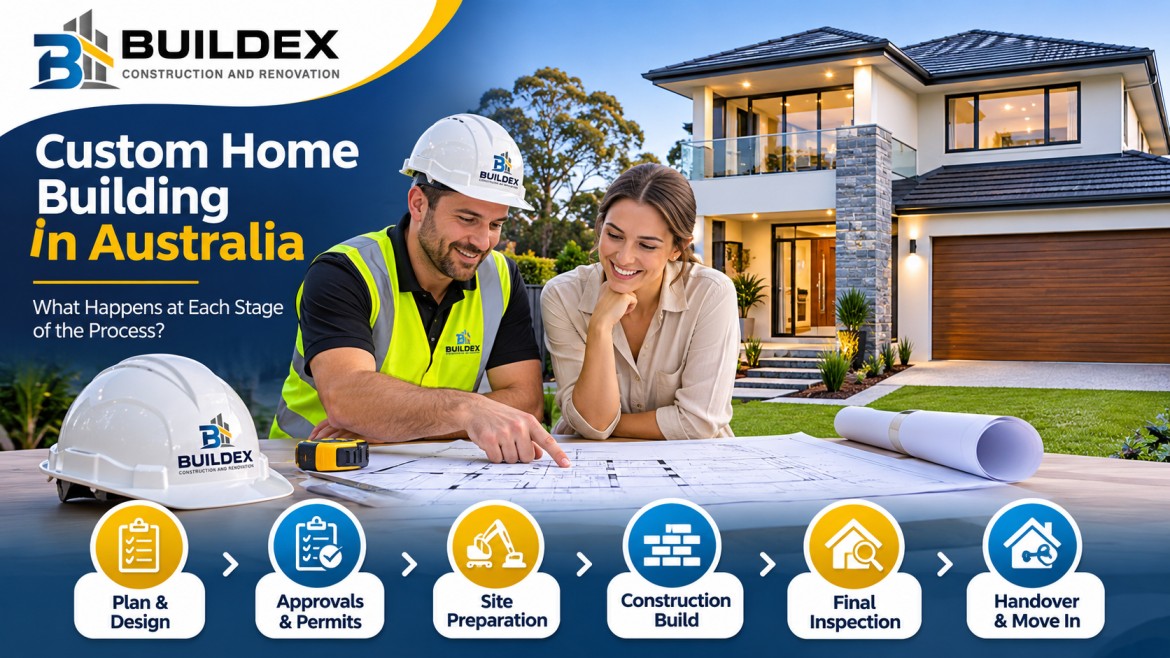
Most Sydney owners tell us the same thing after handover. The build went fine. The surprises came earlier, from not knowing what came next. A council request nobody expected. A variation nobody budgeted for. A three-week wait for a certifier inspection. This guide explains the custom home building process Australia step by step, so you know what happens at each stage, who is responsible, and where projects usually slip.
We write from what we see on real sites across Greater Sydney, from knockdown rebuilds in the Hills District to steep blocks on the Northern Beaches. If you are comparing quotes from a custom home builder in Sydney, this order of events will help you ask sharper questions and spot gaps in a proposal.
It also helps you walk into your first custom home design consultation Sydney meeting with a clear brief instead of a Pinterest board and a hope.
A project home starts with a fixed floor plan. You pick a façade, a colour scheme and a few upgrades. A custom home starts with your block, your budget and the way your family actually lives.
That freedom changes the process. A custom home builder must deal with site slope, soil type, drainage, bushfire ratings and council controls before anyone draws a final plan. Project builders solve most of these questions once and repeat the design. With custom homes, every answer is new, so the early stages take longer and matter more.
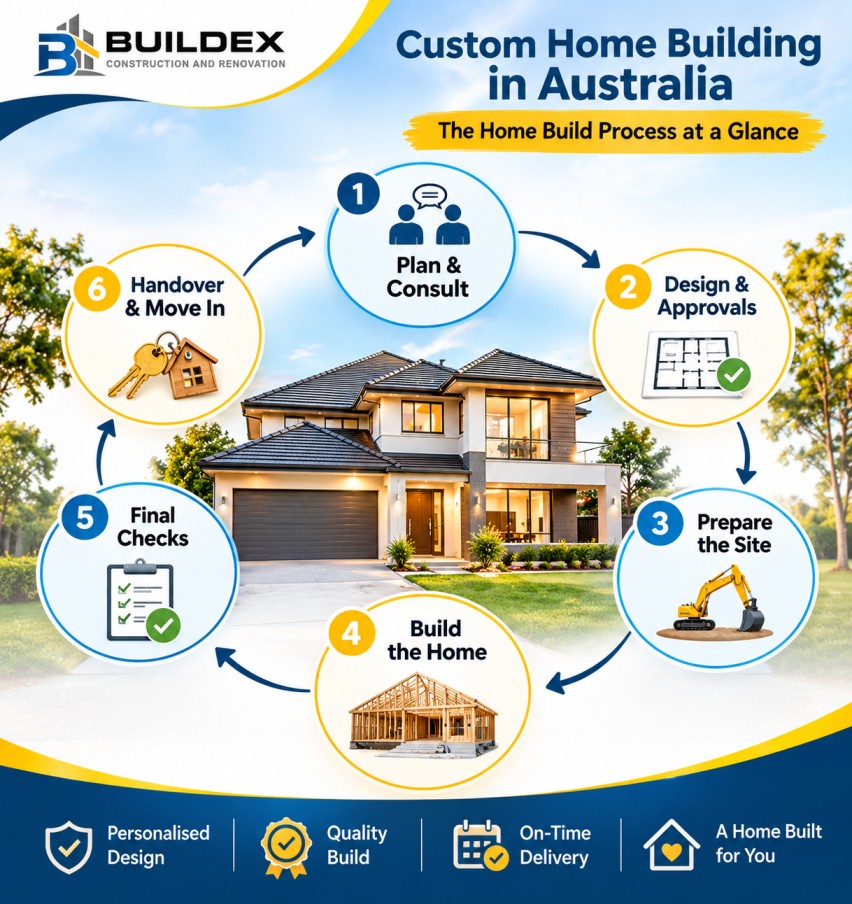
Here is a realistic overview for a two-storey custom home in NSW. Times vary with council, weather and design complexity.
| Stage | Typical time | Key output | Who leads |
|---|---|---|---|
| 1. Site assessment and feasibility | 2 to 6 weeks | Survey, soil report, budget range | Builder, surveyor, engineer |
| 2. Design brief and concept design | 6 to 12 weeks | Concept plans, preliminary costing | Designer or architect with builder |
| 3. Approvals | 3 weeks to 6+ months | CDC or DA, BASIX, Construction Certificate | Certifier or council |
| 4. Contract, insurance and finance | 2 to 4 weeks | Signed contract, HBCF certificate | Builder, lender, owner |
| 5. Construction | 9 to 14 months | Slab, frame, lock-up, fixing | Builder and trades |
| 6. Completion and handover | 2 to 4 weeks | Occupation Certificate, keys | Builder and certifier |
This stage decides whether your dream fits your block and your budget. A good builder orders a detailed survey and a geotechnical (soil) report before quoting anything firm.
Skip this step and you guess. One Baulkham Hills family we worked with had a sloping block and no soil report. Excavation hit sandstone, and rock removal added about $18,000 they had not planned for. A $1,500 report would have shown the problem in week two.
The design stage turns your needs into plans. Your custom home design consultation Sydney session should cover how you live, not just how many bedrooms you want. Who works from home? Do you host big family lunches? Do ageing parents visit often?
In NSW you usually follow one of two paths. A Complying Development Certificate (CDC) suits designs that meet set planning rules, and a private certifier can often issue it within weeks. A Development Application (DA) goes through council and can take three to six months, sometimes longer.
You also need a BASIX certificate, which sets energy and water targets for the design. After a DA, you still need a Construction Certificate before work starts. Your builder should tell you early which path your design suits, because a small setback change can sometimes move a project from DA to CDC and save months.
In NSW, a licensed builder must take out Home Building Compensation Fund (HBCF) cover for residential work over $20,000, and the deposit cannot exceed 10 percent. Check that both appear in writing before you pay anything.
Read the progress payment schedule closely. Each payment should link to a clear, finished stage, not a date on the calendar. Also check how the contract handles provisional sums and prime cost items. Low allowances make a quote look cheap and then cost you later.
This is the custom home building process Australia step by step on site, and it follows a set order.
Your home builder coordinates around 20 to 30 trades through these stages. Weekly updates with photos keep you informed without the need for daily site visits.
Before handover, walk through the home with your builder and list every defect. Bring an independent building inspector if you can. The certifier then issues an Occupation Certificate, which you need before you move in.
NSW law gives you statutory warranties of six years for major defects and two years for other defects. Keep every certificate, warranty and appliance manual in one folder from day one.
Price alone rarely tells you who will deliver well. Look at how a builder communicates before you sign, because that habit carries through the whole build.
A reliable residential construction company Sydney owners trust will happily show you its licence number, HBCF eligibility, recent completed homes and a sample contract. Ask to speak with two past clients and visit a current site. A tidy, safe site says a lot about the team running it.
At Buildex Construction, we hand every client a stage-by-stage schedule at contract signing, with inspection points and payment milestones marked on it. That one document removes most of the confusion owners describe from past builds. Whoever you choose, ask for the same level of clarity.
A good custom home builder in Sydney will also tell you what they do not do well. Honesty about limits is a stronger trust signal than a glossy brochure.
Many owners chasing affordable luxury homes Sydney wide assume luxury means expensive everything. It does not. The homes that feel most premium usually spend boldly in a few places and stay simple everywhere else.
Mostly, yes. The duplex development process Sydney investors follow uses the same six stages, but approvals and feasibility carry more weight. You need to check minimum lot sizes, frontage rules and whether you plan Torrens or strata subdivision. Bring a builder into the feasibility stage early, because the numbers only work if the design suits both the block and the resale market.
Building a custom home is a long project, but it is not a mystery. When you understand the custom home building process Australia step by step, you can plan your money, time and decisions around each stage instead of reacting to surprises.
Start with proper site reports, use your custom home design consultation Sydney meeting to set a ranked brief, and choose a custom home builder in Sydney who explains every stage in writing. If you want a clear, staged plan for your block, the team at Buildex Construction is happy to talk it through with you.
Most two-storey custom homes in Sydney take 14 to 24 months from first meeting to handover. Design usually takes two to three months, and approvals take anywhere from three weeks under a CDC to six months or more under a DA. Construction itself often runs nine to fourteen months. Rain, rock on site and late design changes cause most delays, so lock in your selections before the slab pour.
A CDC is a fast-track approval for designs that meet set planning rules, and a private certifier can often issue it within a few weeks. A DA goes to council for a merit-based assessment, which suits designs that fall outside those rules, such as reduced setbacks or heritage areas. A DA takes longer and may attract neighbour submissions. Ask your builder to check your design against CDC rules first.
Bring a custom home builder in at concept stage, before plans go to council. A builder can price structural choices, spot drainage or access problems and suggest cheaper ways to achieve the same look. Owners who wait until approvals are done often discover their approved design costs far more than their budget. Fixing that means redesign and reapproval, which can easily add several months to the project timeline.
In NSW, the deposit cannot exceed 10 percent of the contract price. After that, payments usually link to finished stages such as base, frame, lock-up, fixing and practical completion. Your lender may also send its own valuer to confirm each stage before releasing funds. Never pay ahead of work completed on site, and always ask for photos or an inspection report before you approve each progress claim from the builder.
Do a full walk-through with an independent inspector and write down every defect, from paint marks to doors that stick. Test taps, power points, lights, appliances and drainage. Confirm you have the Occupation Certificate, waterproofing certificates, warranties and manuals. Agree on a written timeframe for fixing listed defects. Remember that NSW statutory warranties still protect you after handover, so report any new issue to your builder in writing promptly.