

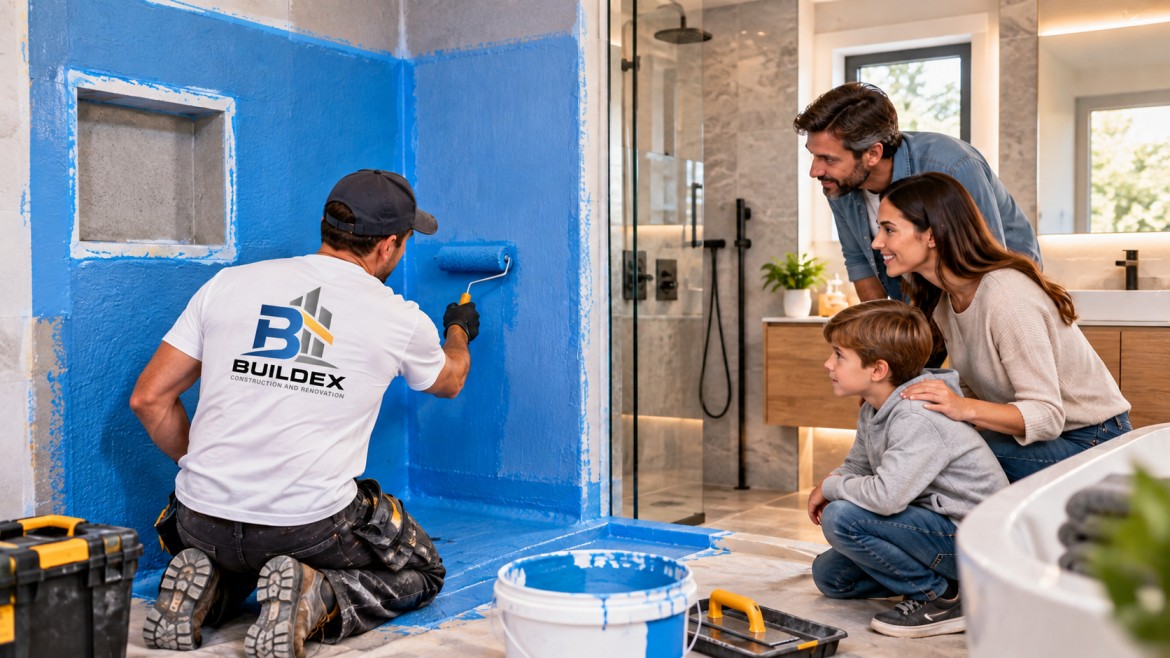
A bathroom can look perfect on the surface while a waterproofing problem quietly develops underneath the tiles. By the time you notice a musty smell, swollen skirting, loose tiles, or staining on the room below, moisture may already have travelled beyond the shower area.
That is why waterproof bathroom renovation Sydney is not simply about choosing attractive tiles or a modern vanity. The waterproofing system behind those finishes is one of the most important parts of the renovation, particularly in shower areas, around floor wastes, wall junctions and plumbing penetrations.
For Sydney homeowners planning a renovation, understanding how waterproofing works can help prevent expensive remedial work later. This guide explains what to look for, how the renovation process should be approached, what can influence bathroom renovation cost Sydney homeowners should budget for, and why proper Bathroom Waterproofing Sydney practices matter from the planning stage through to completion.
Bathrooms are exposed to water every day. Showers create direct water exposure, steam increases moisture levels, and small amounts of water can reach joints, corners and penetrations that are difficult to see once the room has been finished.
Tiles and grout are not, by themselves, the waterproof barrier.
The waterproofing system underneath the finished surfaces is designed to manage moisture and prevent water from entering parts of the building where it can cause deterioration.
This distinction is important because a bathroom may look completely dry while moisture is travelling behind the finished surface.
In NSW, waterproofing is recognised as specialist trade work. The NSW Government states that waterproofing work requires the appropriate licence or certificate, subject to the applicable requirements.
For homeowners, that means waterproofing should not be treated as a minor DIY stage of a larger renovation.
A properly planned renovation considers:
The Australian waterproofing framework also includes AS 3740, with NCC 2022 referencing the 2021 edition of the standard for domestic wet areas.
A good waterproofing job starts before the membrane is applied.
The substrate needs to be suitable, clean, and properly prepared. The installer also needs to understand where water will travel and where movement or penetrations could create potential weak points.
Typical areas requiring careful attention include:
NCC guidance for houses includes specific wet-area waterproofing provisions, and the shower wall waterproofing requirements are particularly important. The NCC 2022 guidance explains that shower walls are required to be waterproofed to a height of 1800 mm under the relevant provisions.
The exact construction approach can depend on the bathroom layout, building type, materials, and compliance pathway.
This is one reason homeowners should be cautious about accepting a quote that simply says “waterproof bathroom” without explaining what preparation and installation are included.
A successful bathroom renovation is easier when waterproofing is considered during design rather than added as an afterthought.
Before demolition begins, think about how the bathroom will actually be used.
Will the shower be open or enclosed?
Will there be a freestanding bath?
Where will the floor waste sit?
Will the shower screen create a completely enclosed area?
Are you changing the position of the toilet, vanity or shower?
These questions influence drainage, floor falls, plumbing locations and waterproofing details.
A visually attractive bathroom design can create practical complications if the wet-area details are ignored.
For example, a large walk-in shower with minimal screening can expose a greater floor area to water. That does not necessarily make it a bad design, but the waterproofing, drainage and floor falls need to be planned accordingly.
Likewise, a wall niche can look excellent in a shower but introduces additional corners and junctions that must be correctly detailed.
The same applies to:
Experienced renovation planning considers these details before the waterproofing stage.
Many Sydney properties have compact bathrooms, particularly apartments, terraces, older homes and smaller townhouses.
A small bathroom renovation Sydney project can still achieve a high-quality result, but limited space makes planning even more important.
In a small bathroom, the shower may be close to the vanity, toilet and door. This means water management becomes particularly important.
A practical approach is to think about the room in zones.
This is normally the area receiving the most direct water exposure. The waterproofing strategy needs to account for the shower floor, surrounding walls, corners, penetrations, and drainage.
Water can escape beyond the shower depending on the layout and screen design. Floor protection and appropriate falls therefore matter.
Every penetration through a waterproofed surface deserves attention. Poorly sealed penetrations can become weak points even when the rest of the membrane has been installed correctly.
The transition between the wet area and the rest of the home should be considered carefully, particularly where water could migrate outside the bathroom.
A small room does not necessarily require fewer waterproofing considerations. In some cases, the opposite is true.
A modern bathroom transformation Sydney homeowners can enjoy for years should combine appearance with durability.
It is easy to focus on:
These features create the visible result, but the work underneath determines much of the bathroom’s long-term performance.
Think of waterproofing as the part of the renovation you hope you never have to notice.
If it has been designed and installed correctly, you should not see it.
If it fails, however, the consequences can become obvious very quickly.
One of the most common mistakes is assuming that grout provides the waterproofing.
Grout can help create a finished, cleanable surface, but it should not be treated as the primary waterproofing system.
Another mistake is rushing the waterproofing stage because the homeowner wants the tiling completed quickly.
Membrane systems require appropriate preparation and curing according to the product manufacturer’s requirements. Installing subsequent finishes too soon can compromise the intended performance of the system.
Other common mistakes include:
These issues may not become visible immediately.
That is precisely what makes waterproofing defects frustrating.
A luxury bathroom is not automatically a better-performing bathroom.
In fact, expensive finishes can make waterproofing mistakes more costly because removing premium tiles, stone or custom fixtures for remedial work can be disruptive and expensive.
For luxury bathroom renovation services, the technical planning should match the quality of the finishes.
Consider a bathroom with a large walk-in shower, stone surfaces, concealed plumbing and a linear drain.
It may look straightforward once completed.
Behind the finished surface, however, there are multiple interfaces between waterproofing, drainage, plumbing, substrates, and fixtures.
Every one of those interfaces needs to be considered before installation.
While specific installation methods vary according to the system being used, a properly managed renovation generally follows a logical sequence.
Before demolition or reconstruction, existing problems should be identified.
Look for:
If an existing bathroom has suffered water damage, simply covering the affected area with new finishes is rarely the best solution.
The waterproofing system depends on a suitable substrate.
Surfaces may need cleaning, levelling, repair, or other preparation before waterproofing begins.
Pipe penetrations, drains and fixtures need to be positioned correctly.
This is where renovation sequencing becomes important. Plumbing changes should be coordinated before waterproofing rather than after the membrane has been installed.
The selected membrane or system should be installed according to the relevant requirements and manufacturer’s instructions.
Corners, junctions and penetrations deserve particular attention.
The membrane should be given the required time before subsequent work proceeds.
This is not a stage worth rushing to save a day.
Once the waterproofing stage has been properly completed, tiling and other finishes can proceed.
Fixtures are installed, and the completed bathroom should be checked for drainage, leaks, fixture operation, and general workmanship.
There is no single price that accurately represents every bathroom renovation.
The bathroom renovation cost Sydney homeowners encounter can vary substantially depending on the existing condition and the desired scope.
Major cost factors include:
Waterproofing itself should not be viewed as an optional upgrade.
If the renovation requires waterproofing, it is part of the technical foundation of the project.
A cheaper quote that excludes necessary preparation may not actually be cheaper once the complete scope is compared.
Before signing a renovation agreement, homeowners should ask practical questions rather than relying only on photographs of previous bathrooms.
Ask:
Clarify whether it is completed by the renovation contractor, a specialist waterproofing contractor, or another licensed trade.
Ask for the product or system details rather than accepting a vague description.
Make sure the scope is clear.
These details can tell you whether the contractor has properly considered the wet-area system.
Ask what records, certificates or compliance documents will be provided.
It is better to understand potential variations before demolition than to receive an unexpected cost halfway through the project.
NSW Government guidance confirms that residential bathroom renovation work above the applicable $5,000 threshold requires the relevant contractor licensing arrangements.
Apartment and strata bathroom renovations have another layer of complexity.
NSW Government guidance states that permission is required for kitchen or bathroom renovations in strata properties, along with changes affecting walls, floors or ceilings. Homeowners should check their scheme’s by-laws and approval requirements before beginning work.
This matters because waterproofing work can affect areas beyond your immediate bathroom.
A leak from an upper-level apartment, for example, can damage the ceiling or finishes of the property below.
Before work begins, confirm:
Do not assume that owning the apartment means every part of the bathroom can be altered without approval.
A few simple decisions can make the renovation process considerably easier.
Before the walls and floors are covered, take clear photographs of plumbing, waterproofing and other important concealed work.
Photographs can be useful for future maintenance or renovation work.
Store information about waterproofing products, tiles, grout, sealants and fixtures.
If something needs repairing several years later, knowing what products were originally used can save time.
A bathroom renovation can feel slow when the room is unusable, but waterproofing is not an area where rushing makes sense.
If you decide to move a shower, change the drain or add a wall niche after waterproofing, stop and confirm how the change affects the waterproofing system.
After completion, check for:
Early attention is much easier than waiting for visible building damage.
They don’t replace the waterproofing system.
Sealant has an important role, but it cannot compensate for a poorly designed or incorrectly installed waterproofing system.
The screen reduces water spread but does not eliminate exposure.
New bathrooms can develop waterproofing defects when installation, product selection or detailing is incorrect.
A quote should be assessed based on the complete scope, materials, workmanship, compliance requirements and what is actually included.
One of the most useful lessons from renovation work is that waterproofing should be treated as part of the bathroom’s structure and function, not simply another line item.
If you are planning a renovation, make waterproofing part of the conversation from the first design meeting.
Don’t wait until the tiler is ready to start.
Discuss drainage, shower configuration, penetrations, floor falls and wall finishes before construction begins.
Also, ask for documentation.
A reputable renovation process should make it reasonably clear who completed the waterproofing, what system was used, and what compliance documentation applies to the project.
For plumbing work, NSW Government guidance states that a Certificate of Compliance confirms that plumbing and drainage work complies with the applicable legislation, regulations and relevant requirements, and must be provided to the person who arranged the work.
The exact documentation required can vary according to the property and scope of work, so homeowners should confirm requirements with their contractor and relevant NSW authorities.
A bathroom renovation is one of those projects where the most important work is often the work you never see.
Beautiful tiles, quality fixtures and clever bathroom design create the visible result, but waterproofing, drainage, substrate preparation and careful detailing determine how well the bathroom performs over time.
For homeowners considering a waterproof bathroom renovation in Sydney, the best approach is to plan waterproofing from the beginning, use appropriately qualified trades, understand the applicable requirements and avoid shortcuts that may create problems behind the finished surfaces.
Whether you are planning a small bathroom renovation Sydney project, a complete modern transformation, or a high-end bathroom remodel, the same principle applies: get the hidden work right before investing in the visible finishes.
Waterproofing helps prevent moisture from entering building elements behind and below finished surfaces. A bathroom can appear finished while hidden moisture is causing deterioration underneath. Proper waterproofing is particularly important around showers, floor wastes, corners, and plumbing penetrations. Addressing these details during the renovation is generally far easier than trying to locate and repair concealed water damage later.
The requirements depend on the type and scope of work, the building, and the wet-area configuration. Domestic wet areas are covered by the relevant NCC provisions and applicable Australian Standards. AS 3740 is one of the key references for domestic wet-area waterproofing, while the NCC provides applicable compliance pathways.
Warning signs can include persistent musty smells, mould that keeps returning, loose or drummy tiles, damaged skirting, staining on adjacent walls or ceilings, swollen cabinetry and unexplained dampness. However, visible symptoms do not always identify the actual source. If you suspect concealed water damage, professional investigation is preferable to simply resealing visible joints.
There is no reliable single price because the cost depends on the bathroom’s size, existing condition, plumbing layout, materials, waterproofing requirements, fixtures, cabinetry and labour. A renovation involving extensive demolition and plumbing relocation can be substantially different from a straightforward refurbishment. Ask for an itemised scope so waterproofing, preparation and other essential work are clearly identified rather than comparing headline prices alone.
Check that the contractor is appropriately licensed for the work, ask who will complete the waterproofing, confirm what waterproofing system will be used, ask how penetrations and junctions will be treated, and establish what documentation you will receive. For strata properties, confirm approval requirements before construction begins. NSW Government guidance also confirms specific licensing requirements for bathroom renovation and waterproofing work above the applicable thresholds.