
A duplex looks simple on paper. Knock down one old house, build two new ones, then live in one and sell or rent the other. In practice, it is one of the most complex residential projects you can take on in Sydney. Many owners call dual occupancy builders Sydney families recommend, only to learn their block needs more checks first.
Zoning, lot width, slope, stormwater, separate services, subdivision and finance all have to line up. Get one wrong and the numbers stop working. This guide explains what experienced duplex builders in Sydney check before a project starts, what it really costs, and how to avoid the mistakes that sink first-time developers.
We also break down duplex construction costs Sydney owners should budget for, including the items most early estimates leave out.
The planning rules shifted in recent years. Since 1 July 2024, NSW reforms have permitted dual occupancy in most R2 low density residential zones across the state, subject to development consent. Before that, many Sydney councils banned duplexes in large parts of their R2 land.
Within mapped Low and Mid-Rise Housing areas near nominated stations and town centres, state standards now set a minimum lot size of 450 square metres, a minimum lot width of 12 metres and a maximum floor space ratio of 0.65:1. Outside those areas, each council’s own minimum lot sizes and controls still apply, and they vary widely across Sydney.
That is why good dual occupancy builders Sydney owners hire always start with a planning check. A block that qualifies in one suburb may not qualify two streets away.
The duplex development process Sydney projects follow usually runs through seven stages. Knowing them helps you plan time and cash flow.
Experienced duplex builders in Sydney manage these later stages too. They coordinate the certifier, service authorities and surveyor, so your titles are not held up after the homes are finished.
Owners often ask for one price per duplex. That number hides most of the real cost. Duplex construction costs Sydney projects carry fall into three groups, and you need all three in your budget.
As a rough 2026 guide, a mid-range duplex in Sydney often costs $3,000 to $4,500 per square metre to build. Two dwellings of around 230 square metres each can easily land between $1.4 million and $2 million in build cost alone. Premium finishes, basements and difficult sites push costs higher.
Interest, rates, insurance and rent while you build add up over two to three years. Many owners forget these until the bank statements arrive. Add a contingency of 5 to 10 percent on top for surprises such as rock, poor soil or council conditions.
Sydney has plenty of sloping blocks, from the Northern Beaches to the Hills District. Duplex builders for sloping land Sydney owners hire must solve problems that flat sites never face.
At Buildex Construction, we test sloping sites before any design is locked in. On one Hills District block, the land fell steeply away from the street with no easy drainage route. Early talks with the downhill neighbour secured a drainage easement before the DA was lodged. That single step saved the owner a costly pump system and months of delay.
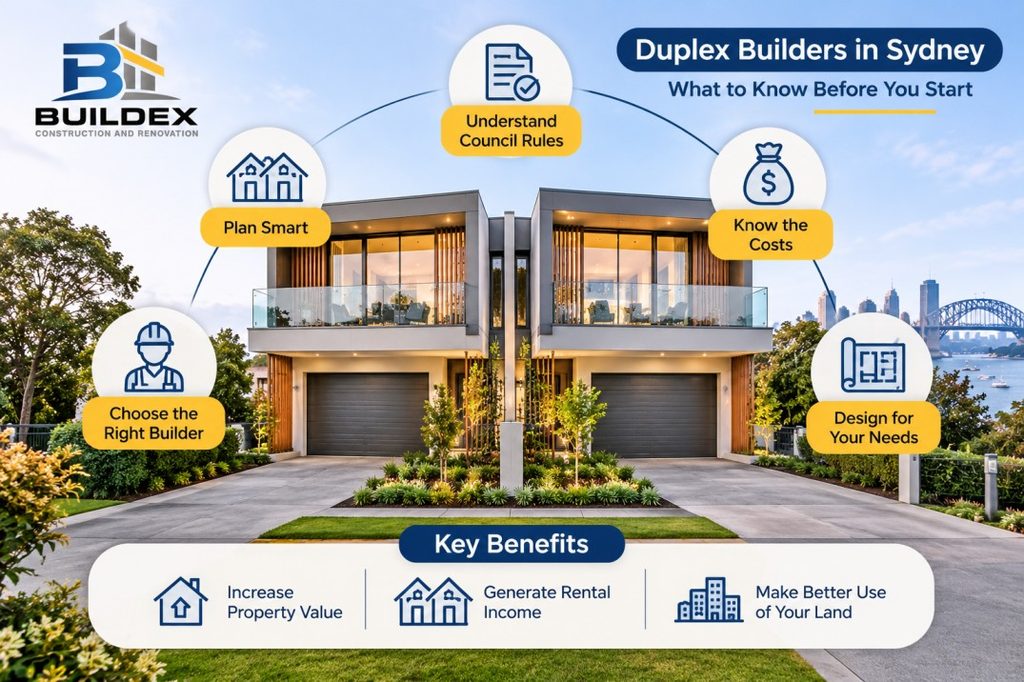
A duplex investment property Sydney buyers want can deliver strong returns, but only when the numbers work. Common strategies include:
Tax matters can change your result. Selling new homes may bring GST obligations, and capital gains tax rules differ depending on how you use each dwelling. Talk to an accountant before you sign anything.
Experienced duplex development builders in Sydney will help you test these scenarios with realistic build costs and timelines, not optimistic guesses.
When you compare duplex development builders in Sydney, ask to see completed duplexes, not just renders, and speak with past clients about budgets and timelines.
A successful duplex starts with a clear feasibility check, not a floor plan. The right duplex builders in Sydney will test your site, your budget and the planning rules before you commit.
Budget for every part of duplex construction costs Sydney projects carry, including site works, consultants, services and holding costs.
Choose dual occupancy builders Sydney owners trust, with completed projects and transparent quotes. If you want an honest feasibility review of your block, the team at Buildex Construction is happy to visit and talk it through.
Most Sydney duplex projects take two to three years from feasibility to separate titles. Design and approvals usually take six to twelve months, depending on whether you use a DA or a CDC. Construction often takes twelve to eighteen months. Subdivision, Sydney Water compliance and title registration can add a few more months after completion, so plan your finance and holding costs around the full timeline.
It depends on where your land sits. In mapped Low and Mid-Rise Housing areas near nominated stations and town centres, state standards set a 450 square metre minimum lot size and 12 metre minimum width. Elsewhere, each council’s own controls apply, and some require much larger lots. Check your council’s planning maps or ask a planner before you buy or design.
Sometimes. A Complying Development Certificate can be faster, but your project must meet every standard in the relevant code, and some councils have limited or suspended this path for dual occupancy. Heritage areas, flood-prone land and some bushfire zones usually rule it out. If your design cannot meet every standard, you will need a Development Application with council instead. A certifier or builder can confirm which path suits your site early.
Torrens title gives each dwelling its own separate lot, with no shared body corporate. It usually suits buyers and lenders better and often achieves higher resale value. Strata title can work when lot sizes or council rules do not allow Torrens subdivision. It involves shared areas and an owners corporation. Ask your planner which option your council allows before design begins.
Good duplex development builders in Sydney will have completed duplexes to show you, not just single homes. Ask to visit finished projects and speak with past clients about budgets, communication and timelines. Check how they handle subdivision, separate services and fire separation between dwellings. Compare quotes on the same written scope, and confirm that site costs, provisional sums and allowances appear clearly before you sign a contract.